
Bolt Size & Torque
Free
Calculate stress area and preload from nominal diameter, pitch, and grade.
Similar calculators
Explore calculators with similar categories or tags.
Calculate stress area and preload from nominal diameter, pitch, and grade.
Overview and entry point for gear design calculations.
Compute gear torque and transmitted forces.
Compute torsional stress and twist angle from torque and shaft size.
Doc version: 1.0 | Updated: 2026-02-07
Compute torque or power from kW, hp, and rpm.
Save this calculation to a local project or export inputs/outputs.
Exports inputs and outputs only.
Smart checks, ranges, and next-step suggestions based on your inputs.
Generate a report
Create a report output to document this calculation.
Create a shareable link or open a print-ready report.
T_input = 9550 * P_input / n | P_output = η * P_input | T_output = η * T_input | P = T * n / 9550 | n = 9550 * P / T
Reference for kW-hp conversion.
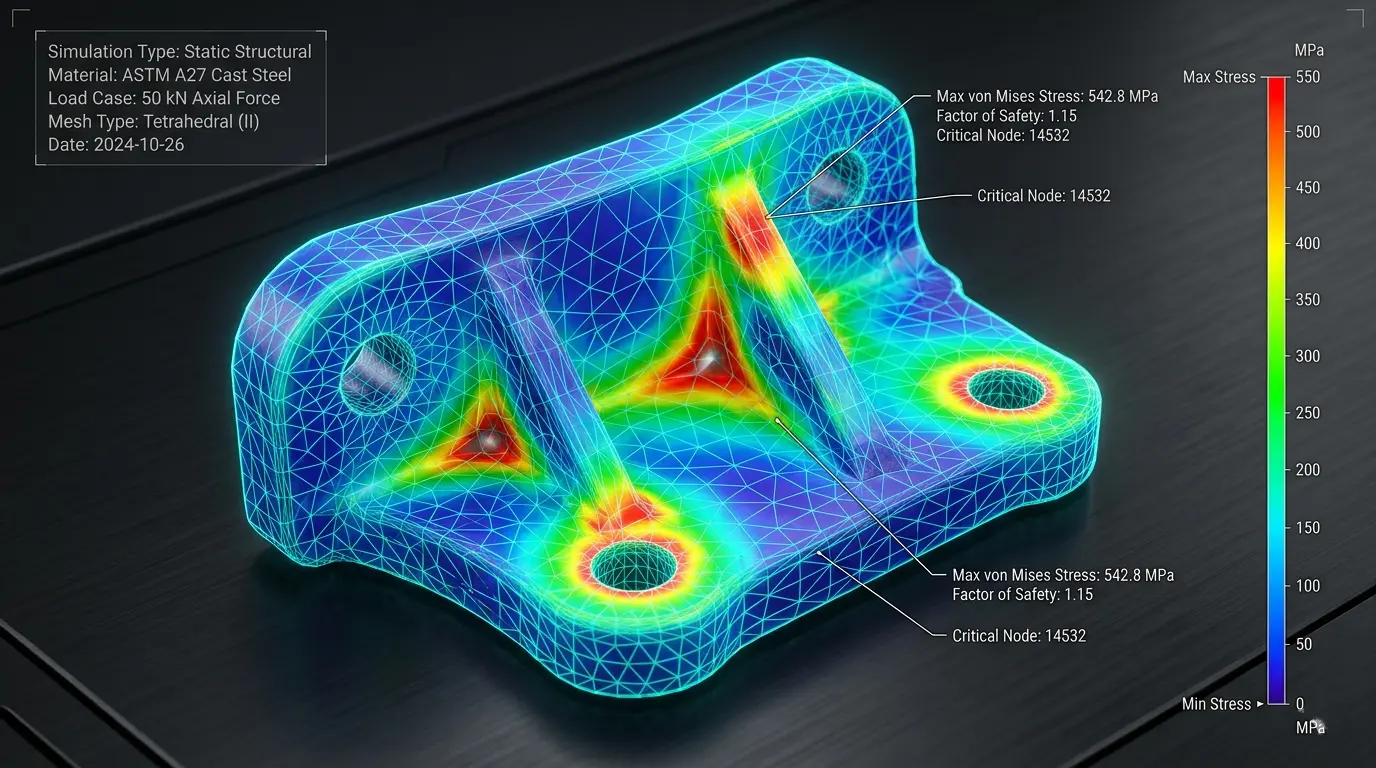
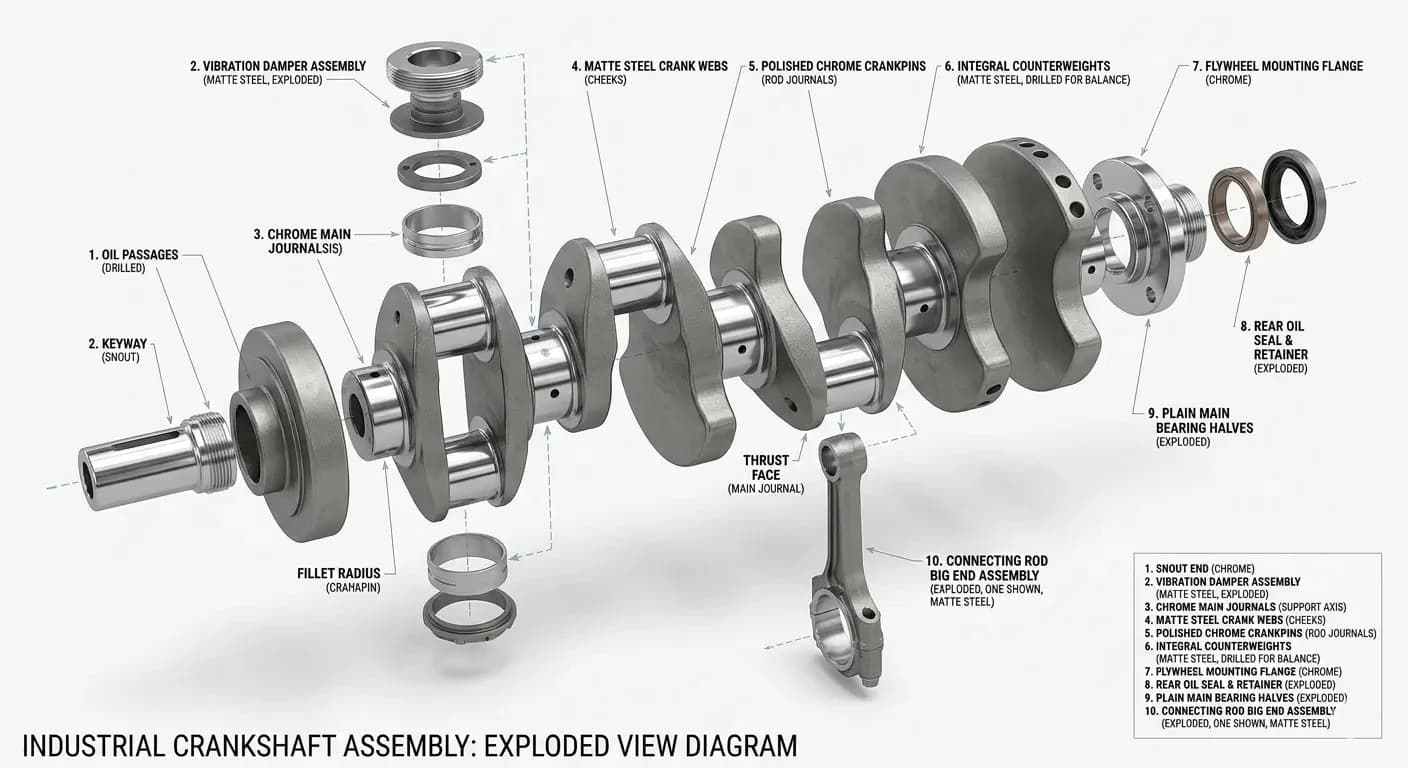
Mechanical power is defined physically as the rate at which work is performed over time. In rectilinear motion, power is the dot product of force and linear velocity (P = F · v). In rotational mechanics, this translates directly to the product of shaft torque and angular velocity:
P = T · ω
Where:
ω = (2 * π * n) / 60 ≈ (π * n) / 30 [rad/s]
P_watts = T * (2 * π * n / 60) = (2 * π / 60) * T * n
1000 * P_kW = (2 * π / 60) * T * n
T = (1000 * 60) / (2 * π) * (P_kW / n)
Evaluating the numerical scalar term:
60000 / (2 * π) = 30000 / π ≈ 9549.29658... ≈ 9550
This yields the widely adopted mechanical engineering design formula:
T = (9550 * P_kW) / n [N·m]
T_eff = T_ideal * (η / 100)
1 kW = 1000 / 745.69987 ≈ 1.34102 hp
hp = kW * 1.34102
A practical verification using the calculator's out-of-the-box parameters illustrates the workflow:
T_ideal = (9550 * 5.5) / 1500
T_ideal = 52525 / 1500 = 35.0167 N·m
Rounding to standard two decimal places yields 35.02 N·m.
Accounting for the 5% mechanical transmission dissipation:
T_eff = 35.0167 * (95 / 100) = 35.0167 * 0.95 = 33.2658 N·m
The net available torque at the driven load is 33.27 N·m.
P_hp = 5.5 * 1.34102 = 7.3756 hp ≈ 7.38 hp
ω = (2 * π * 1500) / 60 = 157.08 rad/s
P_net = 33.2658 N·m * 157.08 rad/s = 5225.4 W = 5.225 kW
Since 5.5 kW * 0.95 = 5.225 kW, the energy balance is verified exactly.
The exact conversion term 60000 / (2π) equals 9549.29658. Rounding to 9550 simplifies workshop calculations and introduces an error of only 0.0073%, which is vastly smaller than standard commercial motor voltage tolerances (typically ±5%) or manufacturing variations in efficiency.
No, torque alone yields only pure torsional shear stress: tau = 16 * T / (pi * d^3). Practical drive shafts also experience bending moments caused by overhung belt tensions, gear meshing forces, and weight, as well as stress concentration notches at shoulders and keyways. A full ASME B106.1M or Soderberg fatigue analysis is required for definitive shaft sizing.
A setting of 100% efficiency represents an idealized, lossless machine where no energy is dissipated by bearing friction, churning, or windage. In this theoretical limit, effective torque equals ideal torque (T_eff = T_ideal).
Below rated base frequency (e.g., below 50 Hz), modern VFDs maintain a constant V/f ratio, preserving rated magnetic flux and delivering constant available torque while power scales linearly with speed. Above base frequency, the motor enters the field-weakening zone where voltage is capped, maintaining constant power while torque drops inversely with speed.
Rated torque is the continuous operating torque at nominal nameplate power. Pull-up torque is the minimum torque developed during acceleration from rest to breakdown speed. Breakdown torque is the peak torque capability before the motor stalls, typically 200% to 350% of rated torque.
P(kW) = T(N·m) * n(rpm) / 9550 | T = 9550 * P / n | hp = kW * 1.34102 | T_eff = T * ηLast updated: 2026-02-07
References
Assumptions
Guides
Browse guides with similar tags.
DIN 6885 shaft-hub parallel keys, shear and bearing crushing stress verification, wedge mechanics, and self-locking conditions.
High-cycle fatigue analysis, S-N Wöhler curves, Marin modification factors, Goodman failure criterion, and Miner cumulative damage rule.
Rotor static and dynamic balancing, ISO 21940 balance quality grades, ISO 20816 vibration severity levels, and resonance mitigation guide.