
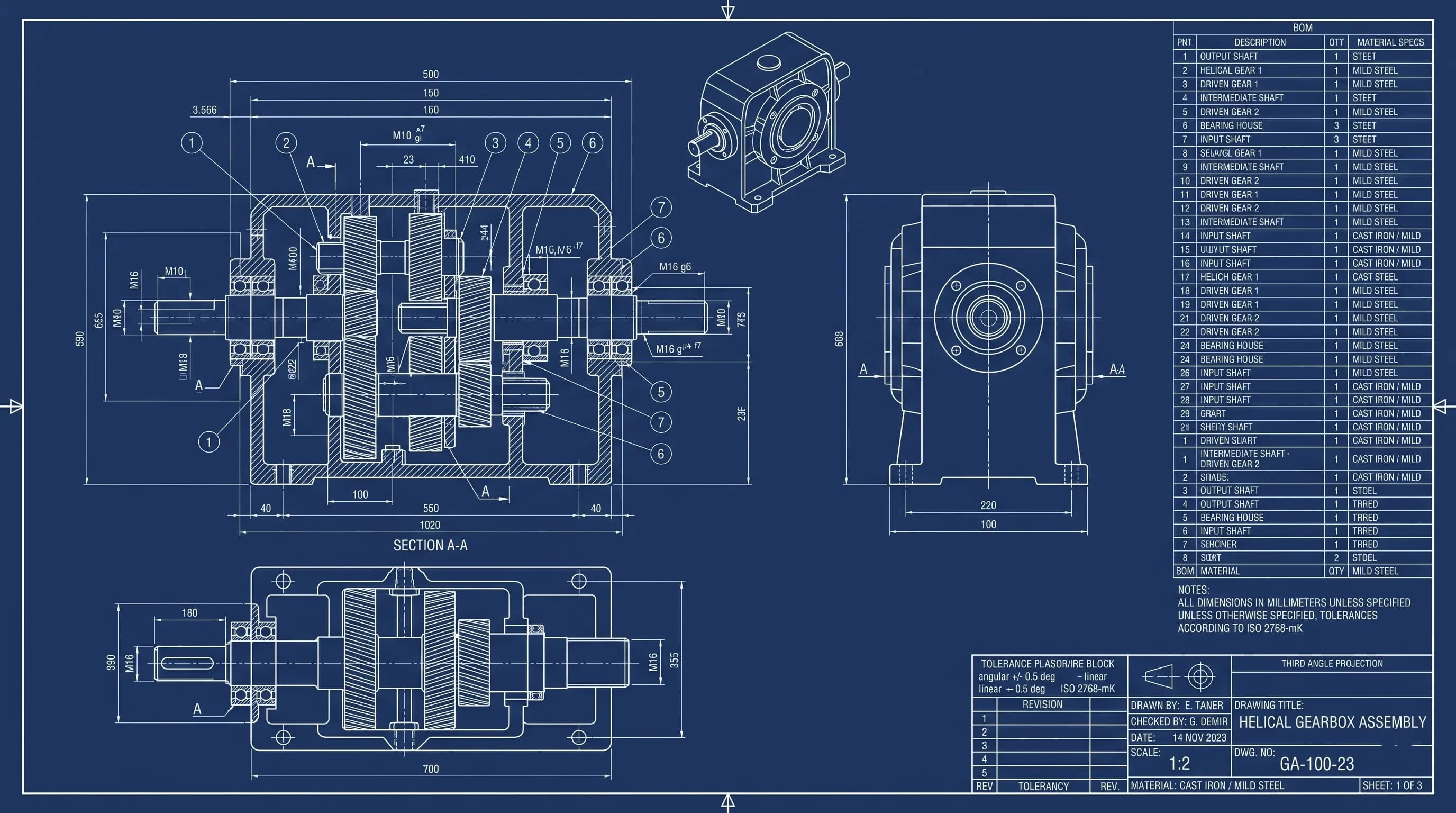
Why TORQYX? — Deterministic Engineering Vision
The most significant bottleneck in mechanical design and product development is the effort required to verify the accuracy and traceability of calculations. Complex spreadsheets with hidden formulas, uncited assumptions, and results that vary from engineer to engineer lead to design errors and expensive prototype revisions in modern industry. TORQYX was engineered to make mechanical calculation transparent, repeatable, and independently verifiable: a deterministic computing platform rooted in international engineering standards that delivers identical results for identical inputs every time.
Developer & Core Disciplines
TORQYX is developed and maintained by an independent mechanical engineer and software developer. Every calculation module on the platform is authored from the ground up based on governing international standards (ISO, DIN, EN, VDI) and foundational academic engineering literature.
Mechanical Design & Strength
Machine elements (fasteners, shafts, keys, springs, gears), static and fatigue strength evaluations coded via analytical equations.
Manufacturing & Tolerancing Systems
ISO tolerance systems (ISO 286), general manufacturing tolerances (ISO 2768), and fillet weld sizing (Eurocode 3) built directly to standard norms.
Thermal & Fluid Systems
Pipe friction losses (Darcy-Weisbach), hydraulic cylinder sizing, and flow regimes solved using analytical equations.
Algorithmic Verification & Testing
The calculation engine is continuously verified by more than 415 automated unit tests (Vitest), locking dimensional units and boundary condition integrity.
Quality Assurance & Calculation Methodology
Transparent Formulas & Traceability
Calculations are never black boxes; governing physical equations and intermediate variables are published with clear mathematical notation.
412+ Automated Unit Tests
Every calculator is continuously tested against textbook benchmark problems and boundary conditions to ensure zero regression across deployments.
Bidirectional Dimensional Consistency
Unit conversions between SI metric and US Customary systems strictly adhere to ISO conversion factors with validated floating-point precision.
Boundary Checks & Safety Alerts
When inputs violate physical realism or yield factors of safety below recommended standards, proactive engineering warnings are triggered.
Transparent Changelog & Versioning
Formula enhancements, new tool implementations, and standard updates are documented publicly with precise version logs.
Governing International Standards & Academic Literature
Our calculation architectures are built upon recognized academic literature and international engineering codes:
- Shigley's Mechanical Engineering Design — Richard G. Budynas, J. Keith Nisbett
- VDI 2230: Systematic calculation of high duty bolted joints (VDI Standards)
- ISO 898-1 / DIN 931 / DIN 933: Mechanical Properties and Dimensions of Fasteners
- ISO 281 & ISO 76: Dynamic and Static Load Ratings and Basic Rating Life of Bearings
- DIN 6885: Parallel Keys and Keyways — Dimensions and Allowable Bearing Pressure
- EN 1993-1-8 (Eurocode 3): Design of Steel Structures — Design of Joints
- Darcy-Weisbach & Colebrook-White: Pipe Friction Factor and Hydraulic Head Loss Analysis
- ISO 12241 & ASTM C547: Thermal Insulation for Industrial Piping and Thermal Expansion
Engineering Disclaimer & Scope of Application
- Tools and technical guides on TORQYX are provided to support preliminary mechanical engineering design, validation, academic study, and feasibility reviews.
- For critical industrial, aerospace, life-safety, or regulated structural applications, full official standard texts, verified material test reports (MTR), and certified Professional Engineer (PE) approval are mandatory.
- Service temperature, shock loads, corrosion rates, tightening torque scatter, and environmental factors influence real-world mechanical behavior.