
What is Reynolds Number? Laminar vs. Turbulent Flow Regimes
Understand the dimensionless Reynolds number formula Re = rho v D / mu and the physics distinguishing laminar, transitional, and turbulent pipe flow.
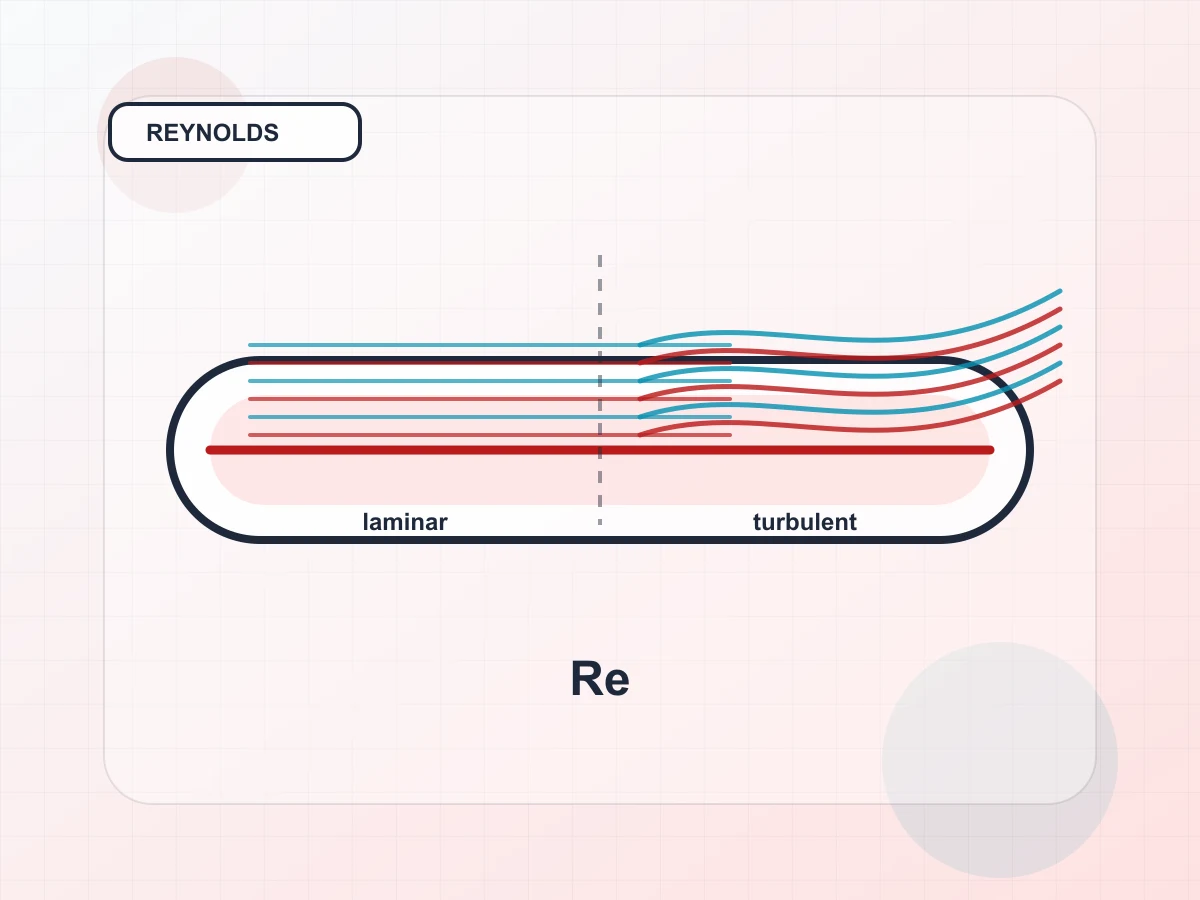
What Does the Reynolds Number Quantify?
The Reynolds number (Re) is a dimensionless ratio comparing inertial forces to viscous forces within a moving fluid:
Re = (ρ * v * D / μ) = (v * D / ν)
Where:
ρ: Fluid density [kg/m ^3]v: Mean flow velocity [m/s]D: Pipe inner diameter (characteristic length) [m]μ: Dynamic viscosity [Pa * sorkg/(m * s)]ν = μ / ρ: Kinematic viscosity [m ^2/ s]
Because it encapsulates the fluid's propensity to either slide smoothly in layers or break up into chaotic eddies, Re serves as the primary diagnostic tool in hydraulic and aerodynamic engineering.
Laminar Flow Regime (Re < 2300)
In laminar flow, fluid particles travel in parallel streamlines without macroscopic cross-mixing:
- Viscous damping dominates inertial momentum.
- The velocity profile across the pipe diameter is parabolic, with centerline velocity reaching twice the average velocity (
v_max = 2 v_avg). - The Darcy friction factor is independent of pipe wall roughness and follows Hagen-Poiseuille law:
f = 64 / Re. - Prevalent in heavy lubricants, hydraulic oils, microfluidics, and low-velocity viscous liquids.
Turbulent Flow Regime (Re > 4000)
In turbulent flow, inertial momentum overwhelms viscous shear, triggering chaotic velocity fluctuations, secondary recirculation, and vortex shedding:
- The velocity profile flattens across the core, producing steep velocity gradients near the pipe wall.
- Fluid mixing and convective heat transfer rates increase substantially, but at the expense of steep hydraulic friction and pressure drop.
- The friction factor depends on both
Reand relative surface roughness (epsilon / D), governed by the implicit Colebrook-White equation.
The Critical Transition Zone (2300 <= Re <= 4000)
The boundary between 2,300 and 4,000 is not a rigid barrier. Pipe vibrations, abrupt pump starts, fitting disturbances, and wall roughness can trigger premature turbulence. In hydraulic design, systems operating in the transitional zone exhibit unpredictable pressure fluctuations and noise; pipes are typically sized to keep flow stably laminar or firmly turbulent.
Temperature and Viscosity Sensitivity
Fluid viscosity is intensely temperature-dependent. For ISO VG 46 mineral hydraulic oil:
- At 20 °C (
ν ≈ 120 cSt), flow through a return line may be completely laminar (Re < 1000). - At 60 °C (
ν ≈ 25 cSt), the same volumetric flow acceleratesRefivefold, transitioning the line into turbulent flow and fundamentally altering cooling and pressure dynamics.
Related Torqyx Calculation Tool
Calculate Reynolds number, flow regime, friction factor, and Darcy-Weisbach head loss using our online pipe pressure tool:
Pipe Pressure Loss Calculator
CalculatorCompute flow velocity, Reynolds number, and Darcy friction pressure drops in standard pipes.
Related Engineering Guides
Reference Standards
- ISO 5167: Measurement of fluid flow by means of pressure differential devices inserted in circular cross-section conduits.
- VDI 2048: Uncertainties of measurement in fluid flow and thermodynamic testing.
Related posts
Darcy-Weisbach Equation: Calculating Pipe Pressure Drop
Calculate frictional pressure loss in pipes using the Darcy-Weisbach formula, Reynolds number, relative roughness, and Colebrook-White friction factor.
What is L10 Bearing Life and How is it Calculated?
Understand 90% reliability L10 bearing life, the governing ISO 281 formula, dynamic capacity C, equivalent load P, and L10h operating hours.
Dynamic and Static Load Ratings: What Do C and C0 Values Mean?
Understand the critical differences between C and C0 in bearing catalogs: fatigue life calculations, plastic indentation limits, and static safety.
Related calculators
Basic Heat Flow
Estimate heat flow through a single layer with manual inputs.