
Darcy-Weisbach Equation: Calculating Pipe Pressure Drop
Calculate frictional pressure loss in pipes using the Darcy-Weisbach formula, Reynolds number, relative roughness, and Colebrook-White friction factor.
Prepared and technically reviewed by: TORQYX Engineering Team · Methodology and team
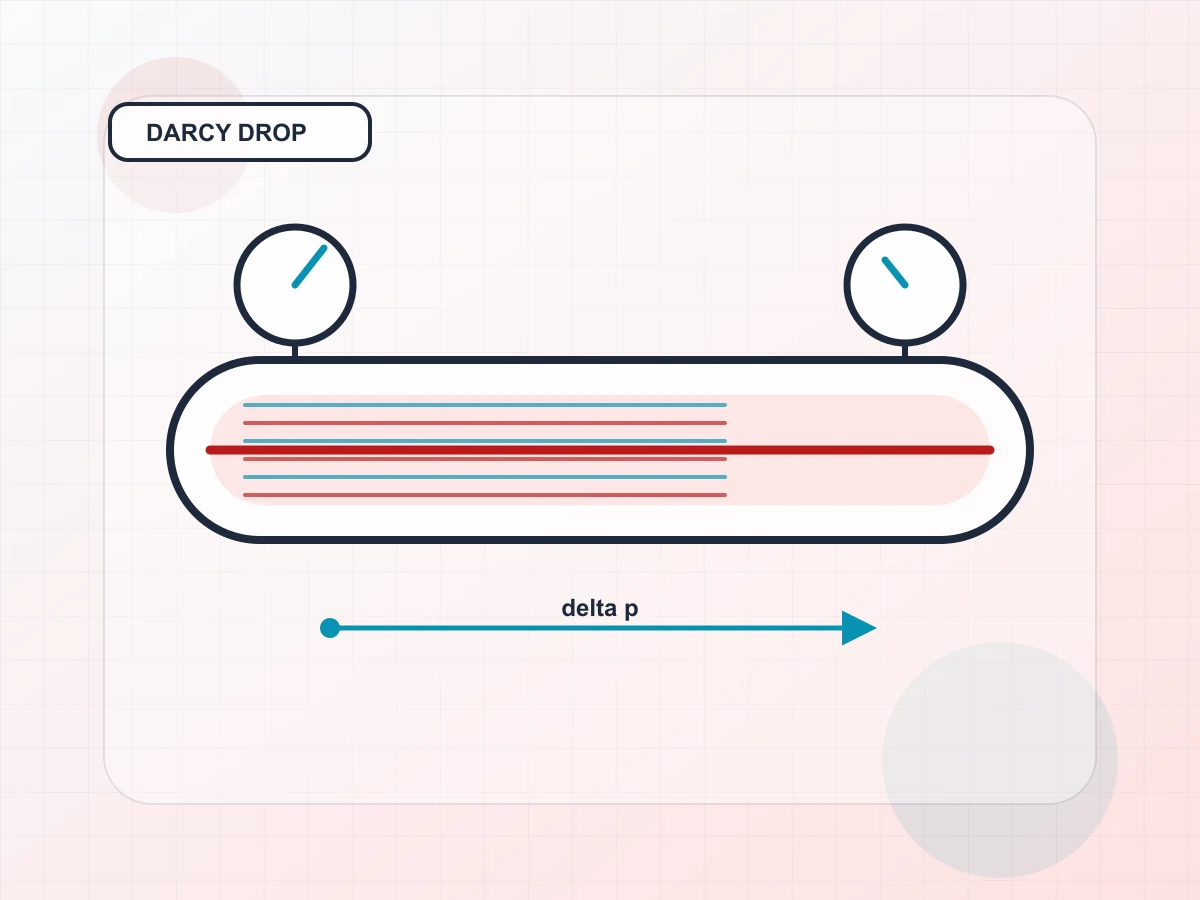
The fundamental model of frictional pressure loss
The Darcy-Weisbach equation is the universally accepted physical model for calculating frictional head and pressure loss in straight, closed-conduit pipe flow. In differential and integrated forms, the pressure drop ΔP across a pipe of uniform cross-section is expressed as:
ΔP = f · (L / D) · (ρ · v² / 2)
where:
- ΔP is the frictional pressure drop (Pa or N/m²)
- f is the dimensionless Darcy friction factor (not to be confused with the Fanning friction factor, where f_Darcy = 4 · f_Fanning)
- L is the pipe length (m)
- D is the pipe internal diameter (m)
- ρ is the fluid density (kg/m³)
- v is the cross-sectional average flow velocity (m/s)
Unlike empirical equations such as Hazen-Williams (which is restricted exclusively to water at ambient temperatures) or Manning's formula (geared primarily toward open channels), Darcy-Weisbach is derived directly from momentum conservation principles. It applies accurately to any single-phase Newtonian fluid—including chilled water, thermal oil, steam, compressed gases, and hydraulic fluids—provided density, viscosity, and flow regime are evaluated at actual operating temperature and pressure.
Step-by-step calculation workflow
A rigorous hydraulic analysis follows four sequential steps:
-
Calculate mean flow velocity: From volumetric flow rate Q (m³/s) and internal pipe diameter D (m): v = 4Q / (π · D²) Verify that velocity remains within recommended engineering velocity guidelines (typically 1.0–2.5 m/s for water supply lines; 3.0–5.0 m/s for pump discharge headers; 15–25 m/s for low-pressure steam or compressed air).
-
Evaluate the Reynolds number (Re): Re = (ρ · v · D) / μ = (v · D) / ν where μ is dynamic viscosity (Pa·s) and ν is kinematic viscosity (m²/s).
- If Re < 2,300: Flow is fully laminar.
- If 2,300 ≤ Re ≤ 4,000: Flow lies in the critical transition zone, where flow stability fluctuates.
- If Re > 4,000: Flow is fully turbulent.
-
Determine the Darcy friction factor (f):
- For laminar flow (Re < 2,300): The friction factor depends solely on viscosity and Reynolds number: f = 64 / Re Pipe wall roughness has zero influence in laminar flow because the viscous boundary sublayer completely submerged surface asperities.
- For turbulent flow (Re > 4,000): Wall roughness ε interacts with turbulent eddies. The friction factor is solved implicitly using the Colebrook-White equation: 1 / √f = -2 · log₁₀((ε / (3.7 · D)) + (2.51 / (Re · √f))) Alternatively, high-precision explicit approximations such as the Swamee-Jain formula can be evaluated directly for screening calculations: f ≈ 0.25 / [log₁₀((ε / (3.7 · D)) + (5.74 / Re^0.9))]²
-
Compute pressure drop and hydraulic pumping power: Calculate ΔP using Darcy-Weisbach. Then estimate hydraulic fluid power required to overcome this friction: P_hyd = Q · ΔP (Watts) Account for pump hydraulic efficiency (η_pump ≈ 0.65–0.85) and motor efficiency (η_motor ≈ 0.88–0.95) to determine actual electrical input power.
The dominant influence of internal pipe diameter
Because velocity depends inversely on the square of diameter (v ∝ 1/D²), and velocity itself is squared in the pressure drop equation, pressure loss scales inversely with the fifth power of internal pipe diameter (ΔP ∝ 1/D⁵) for a fixed volumetric flow rate.
A seemingly modest 15% reduction in internal pipe diameter doubles the frictional pressure loss across the same pipe run. Conversely, selecting one nominal size larger can reduce required pump motor sizing by more than 50%, resulting in lower continuous energy consumption over decades of plant operation. Sizing must balance initial pipe and fitting capital expenditure against lifetime pumping electricity costs, erosion limits, and permissible acoustic noise.
Major losses vs. minor fitting losses
The Darcy-Weisbach equation determines the major loss along straight pipe runs. Real-world piping networks contain valves, elbows, tees, reducers, strainers, and instrumentation. These are termed minor losses (or local losses) and are characterized by a loss coefficient K:
ΔP_minor = Σ K · (ρ · v² / 2)
In long pipelines (such as cross-country municipal water transmission), major friction accounts for 90–95% of total head loss. However, in compact plant skids, chiller rooms, or hydraulic power units, fitting losses often exceed straight pipe friction. Omitting valve and elbow K-factors during early pump selection will lead to an undersized pump that cannot achieve specified design flow.
Common calculation pitfalls
- Mixing Darcy and Fanning friction factors: Many chemical engineering references report the Fanning factor (f_F = f_Darcy / 4). Using f_F in the standard Darcy-Weisbach formula underestimates pressure drop by a factor of four.
- Using nominal diameter instead of actual internal diameter (ID): Schedule 40, Schedule 80, and Schedule 160 steel pipes have identical outside diameters (OD) but drastically different internal diameters. Always use actual measured ID.
- Ignoring fluid temperature effects on viscosity: Fluid viscosity drops exponentially with temperature. Thermal oil or heavy fuel oil at 20°C behaves fundamentally differently from the same fluid at 80°C.
- Neglecting pipe aging and scale build-up: Older carbon steel pipes develop tuberculation, scaling, and corrosion over time, increasing roughness ε from 0.045 mm (new commercial steel) to 0.15–0.5 mm or higher.
Related Torqyx calculator
Use the Torqyx Pipe Pressure Drop Calculator to quickly determine Reynolds numbers, friction factors, and line losses across custom fluid and piping parameters.
Pipe Pressure Loss Calculator
CalculatorCompute Darcy-Weisbach pressure drop, Reynolds number, and friction factors for liquids and gases.
Related engineering guides
- Fluid Dynamics Fundamentals: Pipe and Duct Flow
- Industrial Viscosity and Lubricant Classification Guide
Technical references
- Crane Technical Paper No. 410 (TP-410) — Flow of Fluids Through Valves, Fittings and Pipe.
- ISO 5167 — Measurement of fluid flow by means of pressure differential devices.
- VDI Heat Atlas / VDI 2048 — Fluid dynamic flow measurement and pressure loss principles.
Related posts
Related calculators
Pipe Pressure Loss
Compute Re, friction factor, and pressure loss via Darcy-Weisbach.